

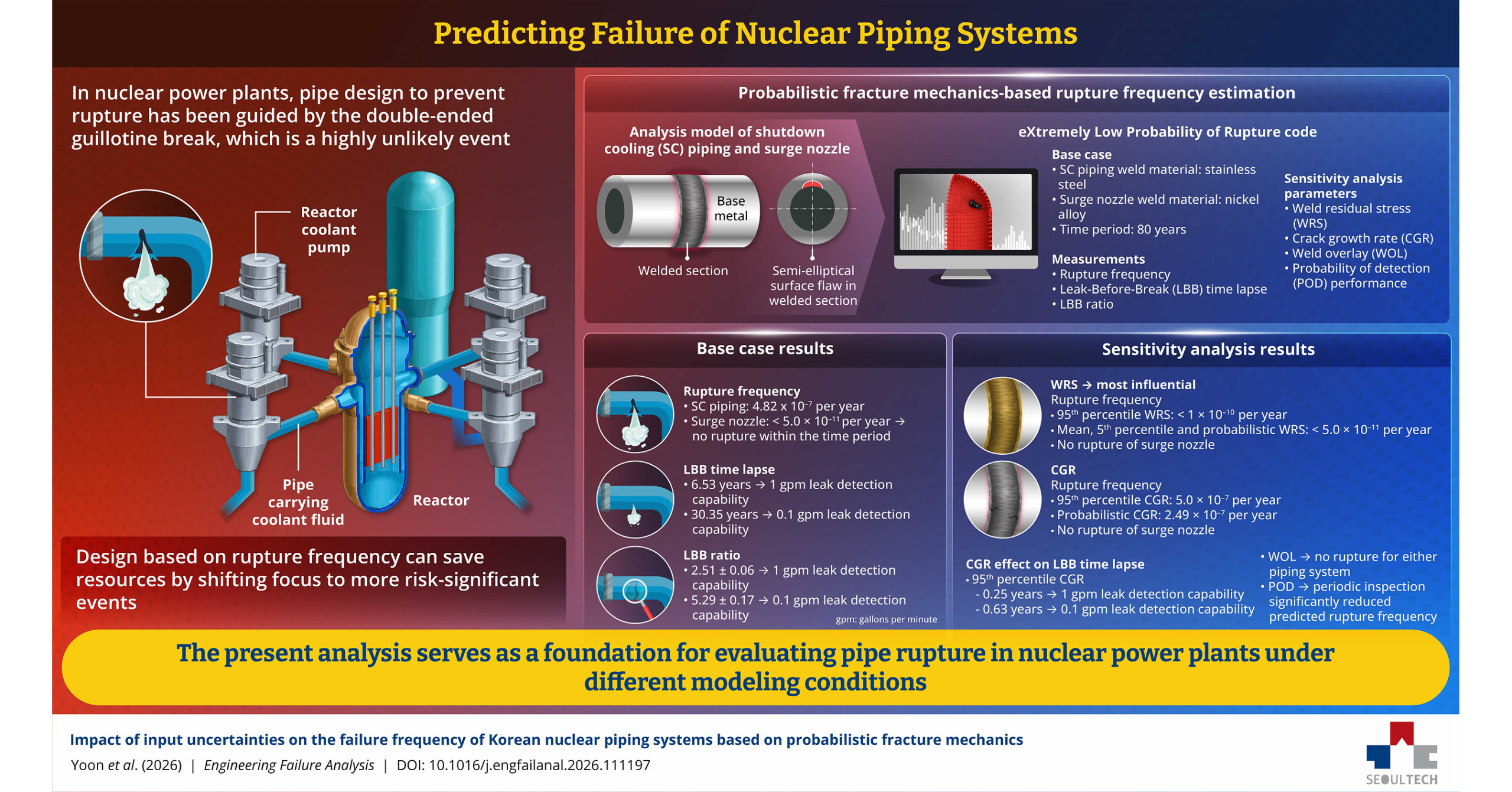
Researchers evaluate the rupture probability of coolant pipes in nuclear power plants using a probabilistic framework
SEOUL, South Korea, Aug. 27, 2026 — In nuclear power plants, the primary coolant piping systems are designed to maintain the structural integrity of the nuclear reactor under normal operating conditions. A pipe rupture that can result in a loss-of-coolant accident is a key consideration in this design and also an important safety concern.
Traditionally, the double-ended guillotine break of the largest primary pipes, which assumes a complete break of the pipe into two sections, has been considered a key design-basis accident. However, such large breaks are extremely unlikely. Assessing the frequency of pipe rupture can therefore help engineers better understand the likelihood of different failure scenarios and focus resources on events that are more relevant to actual risks. Deterministic leak-before-break (LBB) and statistical approaches based on operating experience have been used previously to evaluate rupture frequency, but these methods do not account for degradation mechanisms or the influence of individual parameters.
To address these limitations, a research team led by Professor Nam-Su Huh from the School of Mechanical Systems Engineering at Seoul National University of Science and Technology in South Korea utilized probabilistic fracture mechanics-based sensitivity analysis to investigate the rupture behavior of the Korean nuclear power plant’s piping systems. “Probabilistic fracture mechanics makes it possible to estimate rupture frequency while accounting for the stochastic nature of material behavior, degradation over time, loading conditions, and even effectiveness of inspections,” explains Prof. Huh. Their study was made available online on July 01, 2026, and will be published in Volume 197, Part B of Engineering Failure Analysis on November 01, 2026.
The researchers utilized the eXtremely Low Probability of Rupture (xLPR) code to conduct their assessment. To this end, the researchers selected two LBB-approved piping systems from a reference Korean nuclear power plant—SC piping and a surge nozzle.
The team first established a base case, consisting of a fixed set of parameters, as a reference condition for sensitivity analysis. The researchers simulated 80 years of plant operation, considering stress corrosion cracking (SCC) as the only degradation mechanism. Sensitivity analysis was then conducted to evaluate the effect of weld residual stress (WRS), crack growth rate (CGR), weld overlay (WOL) repair, and inspection performance.
The sensitivity analysis showed that different parameters had varying effects on predicted rupture frequency. WRS was the most influential parameter, with the 95th-percentile WRS profile, producing a considerable decrease in the rupture frequency for SC piping compared with the base case. The effect of CGR was also significant. The surge nozzle showed no rupture in all cases. WOL analysis also showed no rupture for either piping system. Interestingly, periodic inspections significantly reduced the rupture frequency by several orders of magnitude.
“A probabilistic framework can help engineers identify which factors govern the predicted failure behavior, providing a reliable technical basis for plant design and safety evaluations,” remarks Prof. Huh. “In the long term, this research could contribute to risk-informed approaches to maintain the safety of both aging plants and new plants.“
This study contributes to the development of better design and maintenance strategies for making nuclear power plants safer and more economical.
Reference
Title of original paper: Impact of input uncertainties on the failure frequency of Korean nuclear piping systems based on probabilistic fracture mechanics
Journal: Engineering Failure Analysis
DOI: https://doi.org/10.1016/j.engfailanal.2026.111197
About the institute Seoul National University of Science and Technology (SEOULTECH)
Website: https://en.seoultech.ac.kr/
Media Contact
Seo-Hee Yoon
82-2 – 970 – 9166
[email protected]
SOURCE Seoul National University of Science and Technology
