

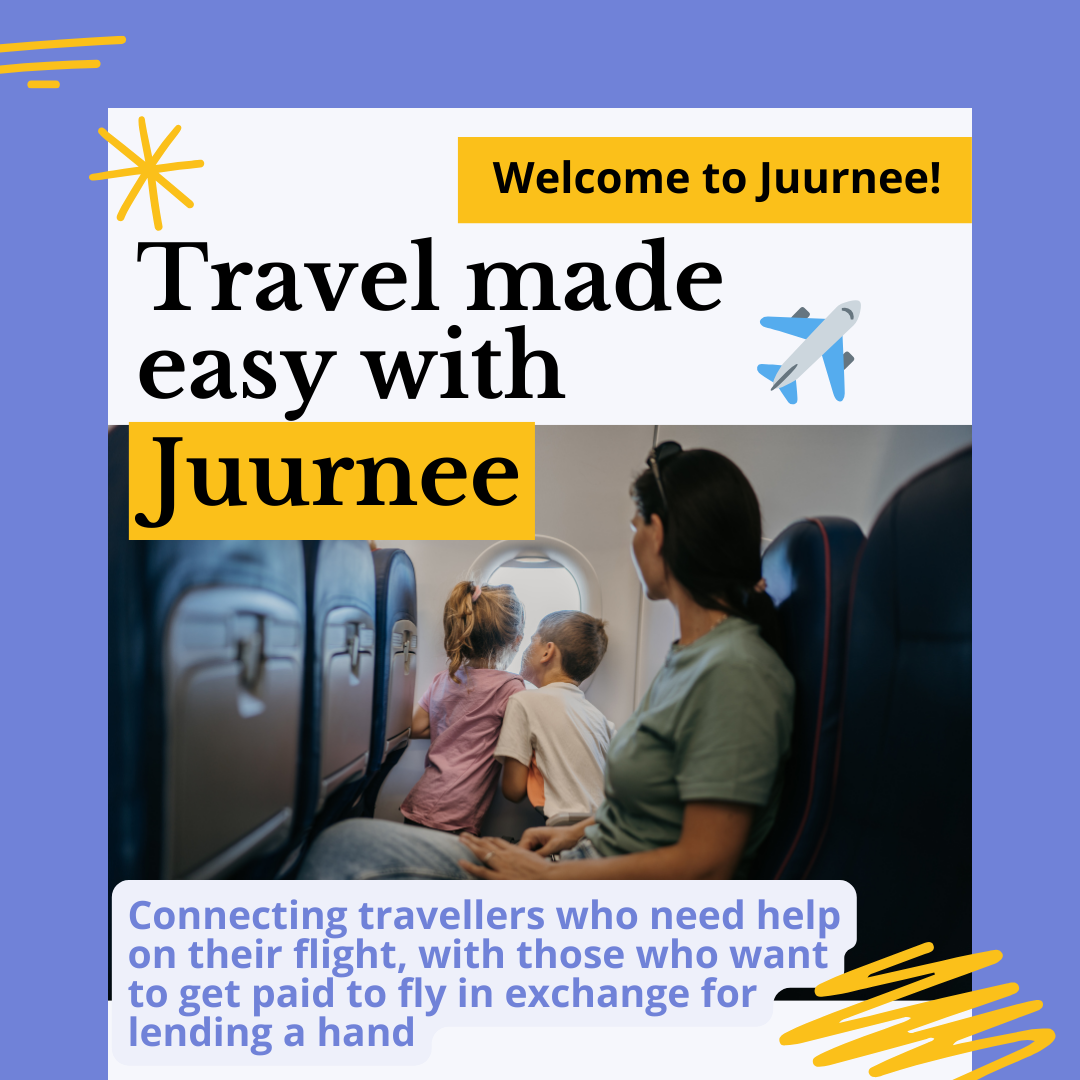
Founded after one mother struggled to find support for a long-haul journey with three young children, Juurnee is connecting travellers who need assistance with people willing to provide it.
A long-haul flight with three young children can be challenging. For Rachel Crampton, the prospect became even more daunting when an unexpected change in family plans left her facing the journey alone. What followed was an exhausting search for help that eventually led her to build Juurnee, a platform connecting travellers who need assistance with people willing to accompany them.
The idea emerged in 2022, when Crampton and her family travelled from Sydney to London for a family wedding. Her partner had to return to Sydney earlier than planned because of work. Their children were four years old, two years old and just four months old. Crampton did not feel she could manage the return journey alone, so she began looking for someone who could help.
She offered to pay $1,000 for a travel companion and eventually found Sarah, who supported her throughout the journey. The experience showed Crampton how difficult it could be to find suitable help for a flight, even when someone was willing to pay for it.
Rather than treat the experience as an isolated problem, she decided to build a service that could make finding and booking a travel companion easier for other families.
Turning a personal problem into a shared solution
Juurnee brings together two groups of travellers. One includes people who need help navigating an airport or managing the demands of a flight. The other includes people who are willing to provide that assistance, potentially in exchange for payment that helps offset their own travel costs.
The support can take different forms. Parents travelling with young children may need another pair of hands with luggage or help keeping children occupied. Older passengers, people with injuries or disabilities, anxious flyers and some unaccompanied minors may also benefit from having someone accompany them.
The premise is straightforward: a person who needs support can find a companion, while someone travelling along the same route may be able to make the trip more affordable by helping.
That practical approach distinguishes the idea from a conventional travel-booking service. The focus is not simply on getting passengers from one destination to another. It is on making the journey more manageable for people who might otherwise struggle to travel independently.
Three founders, different experiences, one common purpose
Crampton’s experience was the starting point, but Juurnee’s development also reflects the experiences of its two co-founders, Aurélie Cornu and Anisha Imran.
Cornu, who serves as growth co-founder, had faced a similar challenge while travelling alone from London to Sydney with her two children during an international move. Her own experience gave her a personal understanding of the problem Crampton was trying to address. She joined the venture with experience in building companies and a focus on helping more people discover and use the service.
For Cornu, the opportunity was closely connected to a situation she had experienced herself. The challenge was not abstract. It involved managing children, luggage and the demands of a long-haul flight without another adult to help.
Imran, Juurnee’s technical co-founder, brings a different perspective. Growing up as a caregiver for her younger sister, who has autism, shaped her understanding of how appropriate support can influence a person’s confidence and independence. It also showed her the difficulties families face when that support is hard to find.
Her role extends beyond developing the technology. The platform’s approach to trust, safety and the human side of travel is central to the experience she aims to build.
Together, the founders bring personal experience of caregiving and solo travel to a business built around a practical need. Their backgrounds also help explain why Juurnee’s proposition centres on human assistance rather than technology alone.
Making travel more accessible, one journey at a time
Juurnee also offers a way for people to reduce the cost of trips they already want to take.
Prospective companions can browse available journeys for free. Those who want to apply for a journey need a Premium membership, listed on the company’s website at A$30 per year. The person requesting assistance specifies the support needed and the payment offered, allowing potential companions to assess the arrangement before applying.
The company recommends that payments be made upfront and held in escrow until the trip is completed, after which the money is released to the companion.
The potential savings can be significant, depending on the route and the payment offered. Juurnee’s website features the example of Ella, who saved $530 on a London-to-Sydney flight after helping a mother and her baby. Another companion, Hayleigh, saved $1,552 on a journey from Sydney to Edinburgh before continuing to Ireland.
These examples illustrate how the arrangement can benefit both parties. The traveller receives assistance, while the companion can offset some of the cost of reaching a destination.
The model does not mean every journey will be fully funded. Its practical value depends on the available routes, the dates, the assistance required and the amount offered.
Building around a need that often goes unnoticed
Travel planning tends to focus on flights, accommodation and itineraries. For some passengers, however, the more immediate question is who will help them through the journey.
Juurnee was created around that gap. Its founders’ experiences suggest that the need for travel assistance is not limited to one type of passenger or circumstance. It can arise when a parent flies alone with young children, when an older relative needs help visiting family or when a passenger needs additional support to travel with greater confidence.
The platform offers one way to connect those who need help with those willing to provide it. Its longer-term role will depend on how effectively it builds trust, brings suitable travellers together and meets the different needs of its users.
For Crampton, the starting point was personal: she needed help with a flight and discovered how difficult it was to find. Juurnee grew from that experience into a service designed to make similar arrangements easier for others.
The broader idea is simple. Sometimes, making travel possible takes more than a ticket. It takes another person willing to help.