

BEIJING, Oct. 15, 2026 — Traditionally, mobile networks have enabled early communication through voice calls, text messaging, and mobile internet access. However, the emerging agentic era requires support to manage a massive number of AI agents. This evolution requires the core network architecture to understand intent, make intelligent decisions, and ensure the end-to-end completion of AI-driven tasks.
Huawei believes that an AI-native core network will be essential to this transformation. By embedding AI into interfaces, functions, and procedures, operators can evolve from providing connectivity alone to delivering intelligent network capabilities for the next generation of digital services.
According to Huawei’s Intelligent World 2035 report, the number of AI agents globally could reach 900 billion by 2035—approximately 100 times the world’s population. With the increasing number of AI agents, the core network architecture must be able to support the long-term growth of new connections and services.
As AI terminals and applications become increasingly adopted, agentic services will emerge as typical scenarios of mobile networks, driving network evolution from transporting data bits to enabling task-oriented tokens.
Huawei identified three typical service scenarios for agentic experience assurance.
- Agent Over New Radio (AoNR) for Task Latency Assurance: Portable AI devices face limitations in computing power, battery capacity, size, and cost, making end-to-end latency essential. AoNR is designed to consistently deliver an excellent experience while keeping end-to-end task latency below demanding thresholds.
- Wide-Area Computing Network (WCN) for Computing Efficiency Gains: A WCN can interconnect computing resources through mobile networks, enabling task-based computing scheduling and standardized computing services.
- Agent Computing Network (ACN) for Collaboration Security Assurance: Most complex tasks will involve multiple AI agents working across domains, enterprises, and ecosystems rather than a single agent, which is constrained by model capabilities, context limitations, role conflicts, or sequential processing challenges. Complex scenarios will require secure, dynamic collaboration among multiple specialized agents.
An ACN enables efficient cross-domain and cross-ecosystem agent collaboration through three capabilities: cross-domain trusted digital identity, skill-based agent discovery and routing, and task-driven dynamic networking.
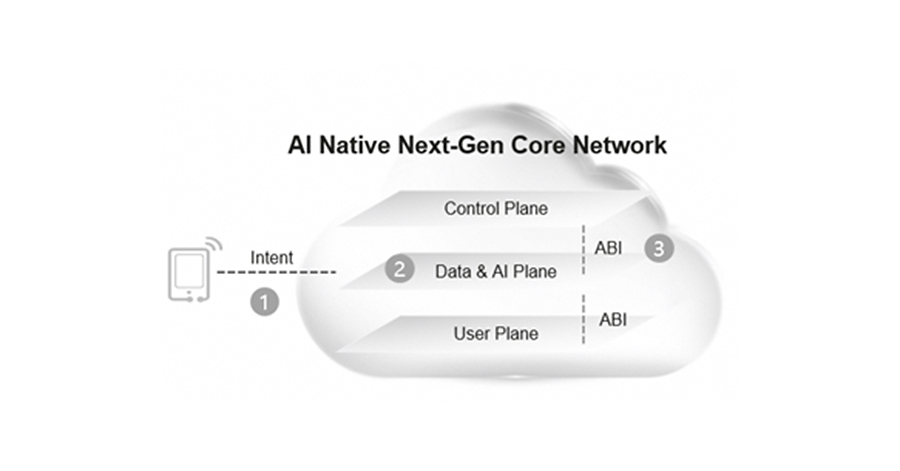
To bridge the gap between terminals and networks, the next generation of core network architecture should have three key characteristics:
- Interfaces (From Signaling to Intent): Intent-based interfaces allow terminals to communicate personalized task requirements—including networking, computing, and experience needs—directly to the network.
- Functions (C/U Planes to C/U+DAP Planes): Introduces a dedicated Data & AI Plane (DAP) alongside traditional control and user planes to act as the intelligence layer, interpreting task intents and dynamically aligning resources in real time.
- Procedures (From AI Overlay to AI-Native): Deeply embeds AI decision-making into fundamental network procedures to coordinate connectivity and computing seamlessly.
Looking ahead, Huawei outlined two stages of the AI-driven core network evolution. Stage one involves how the network enhances customer experiences by overlaying AI capabilities. While stage two is AI native next generation core network, enabling what Huawei describes as “enhanced connectivity”, where task-oriented AI services ensure task completion, and “beyond connectivity”, where the network must provide capabilities beyond communication, such as providing computing service, and facilitating agents collaboration etc. To adapt to these new services, the network architecture will need to be restructured, particularly in interaction mechanisms, data architecture, and computing architecture.
In addition, the transition to AI-native networks requires comprehensive collaboration across the ICT ecosystem, including terminals, chips, and networks. Through the terminal-network synergy mechanism and advanced core network architecture, the next-generation core network enables new connections and services, opening up new business opportunities in the era of intelligence.
