

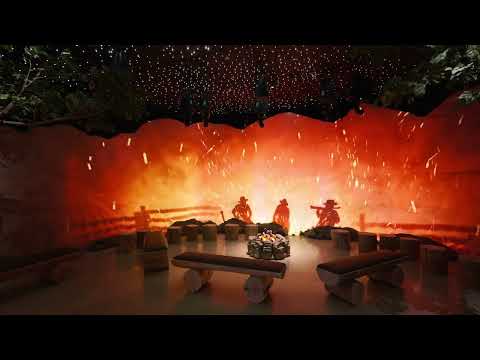
On the ground where a grieving young New Yorker remade himself into a conservationist and a president, a new kind of presidential library opens to the public.
MEDORA, N.D., July 4, 2026 — Theodore Roosevelt came to the North Dakota Badlands in the 1880s as a grieving young New Yorker and left a rancher, a conservationist, and the man who would become the 26th president. Today, on the 250th anniversary of American independence, the Theodore Roosevelt Presidential Library opens to the public on the same rugged landscape that shaped him.
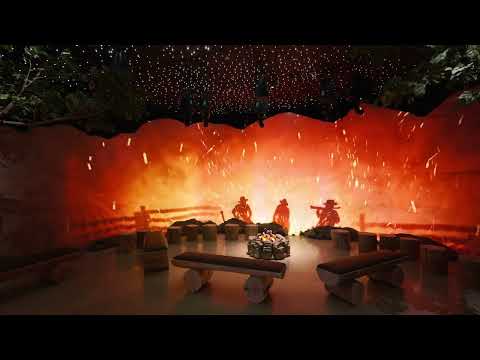
Set on a butte west of Medora at the edge of Theodore Roosevelt National Park, the 96,000-square-foot library and museum is the first institution to gather Roosevelt’s story — scattered across the country for more than a century — in a single place, and to tell it in the landscape where it happened. Designed by the international firm Snøhetta, the building rises out of the butte beneath a sloping, walkable green roof and looks out over the Little Missouri River and the Badlands beyond.
Inside, more than 40,000 square feet of immersive galleries — their story shaped by Future of StoryTelling, their design by Local Projects — carry visitors from Roosevelt’s boyhood specimen collection to his presidency and his final expeditions. The galleries are anchored by 142 original Roosevelt artifacts brought together for the first time, among them the diary in which a 25-year-old Roosevelt recorded losing both his wife and his mother on the same February day in 1884, marking the page with a single line: “The light has gone out of my life.” Outside, a mile-long boardwalk winds across restored native prairie and over the green roof, with trailheads connecting the campus directly to the National Park and the Maah Daah Hey Trail.
The Library is built around three pillars Roosevelt embodied — leadership, citizenship, and conservation — and it is designed to do more than preserve the past. Its galleries, school partnerships, civic-dialogue programs, and a first-of-its-kind digital archive uniting Roosevelt’s papers from institutions nationwide invite people to take up the questions he wrestled with as participants rather than spectators. That invitation has a source: in a 1910 address at the Sorbonne in Paris, Roosevelt said, “The credit belongs to the man who is actually in the arena, whose face is marred by dust and sweat and blood; who strives valiantly; who errs, who comes short again and again, because there is no effort without error and shortcoming; but who does actually strive to do the deeds.” The Library asks every visitor to leave ready to get in the arena in their own communities.
The building also enacts Roosevelt’s conservation ethic in its own structure. Designed to be the only carbon-neutral presidential library in the world, it is pursuing the Living Building Challenge — the most rigorous performance-based green-building standard in the world — along with LEED Platinum and SITES Platinum certification. Its frame is mass timber; its entrance walls are rammed earth made from local soil; and roughly 400,000 native plants have been hand-planted across the 93-acre campus, with a green roof that merges into the surrounding prairie.
The Library’s construction was made possible by private philanthropy — the gifts of benefactors across North Dakota and the nation.
“This is a place where Roosevelt’s story isn’t behind glass — it’s all around you, in the same Badlands that changed him,” said Edward F. O’Keefe, chief executive officer of the Theodore Roosevelt Presidential Library. “None of it would exist without the benefactors who believed in the project, and we’re grateful to every one of them. Opening on the nation’s 250th birthday, in the place he loved, is the way we always wanted to begin.”
“What makes this Library unique is that it focuses as much on the visitor as it does on Theodore Roosevelt,” said Theodore Roosevelt V, who chairs programming and partnerships for the Library’s board of trustees. “It challenges each of us to explore how we can become better citizens, leaders, and conservationists in our own communities.”
The Theodore Roosevelt Presidential Library opens to the public on July 4, 2026, with a ribbon-cutting that morning. Tickets and visitor information are available at trlibrary.com.
About the Theodore Roosevelt Presidential Library
The Theodore Roosevelt Presidential Library opens to the public on July 4, 2026 — the 250th anniversary of American independence — in Medora, North Dakota, on a 93-acre butte at the edge of Theodore Roosevelt National Park. Designed by Snøhetta and built around the pillars of leadership, citizenship, and conservation, the Library brings together for the first time the comprehensive story of America’s 26th president — told through immersive galleries shaped by Future of StoryTelling and designed by Local Projects, 142 original artifacts, a first-of-its-kind digital archive uniting Roosevelt’s papers from institutions across the country, a mile-long boardwalk, and a walkable green roof. Designed to be the only carbon-neutral presidential library in the world, it is pursuing Living Building Challenge, LEED Platinum, and SITES Platinum certification. The Theodore Roosevelt Presidential Library Foundation is an independent 501(c)(3) supported by private philanthropy and a North Dakota state operating endowment. More at trlibrary.com.
SOURCE Theodore Roosevelt Presidential Library
