

During a breakout session at the New York event, the industry-leading AEO platform and press release distribution service discussed what the changing AI search landscape means for communicators and provided six steps they can take now to get their stories seen.
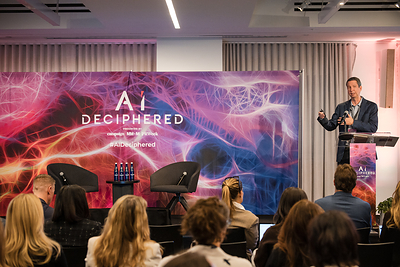
NEW YORK, Nov. 16, 2026 — Last week, PR Newswire addressed the fundamental shift in digital visibility at AI Deciphered 2026 in New York, outlining how brands must adapt as search evolves from human-centric queries into autonomous AI agents. Jeff Hicks, Chief Product and Technology Officer at PR Newswire, detailed how communications teams can transition to “answer-ready” content to remain discoverable by machines that now research, compare and act on behalf of users.
Learn how PR Newswire is innovating to help customers optimize their stories for AI visibility and discoverability: https://www.prnewswire.com/ai-optimized-press-releases/
Data shared during Hicks’ breakout session, “The Next Search Gatekeeper Isn’t Human,” indicates that AI bots now generate 57% of all web traffic, surpassing human-driven traffic for the first time in history. This shift means that brand visibility now depends on the inputs AI models read and verify, rather than traditional search engine rankings alone.
During the session, Hicks explained that brands’ official press releases have emerged as vital data sources for large language models. Releases provide dated, first-party facts through authoritative distribution channels like PR Newswire and satisfy the three primary ways bots consume content: training for long-term knowledge, indexing for eligibility and answering for direct citations.
“The evolution of search into intelligent agents that act on a user’s behalf necessitates a new approach to how we structure communications,” Hicks said. “The press release remains a primary vehicle for brand authority because it serves as verifiable, first-party data that AI agents require to build trust, essentially transitioning the traditional press release into an indispensable information release for both human readers and machine learners.”
6 Practical Steps to Prepare for the Next Era of Search
To close out the discussion, Hicks provided strategic steps for improving AI-driven brand discoverability:
- Audit current AI answers: Organizations should query the AI tools their customers use to score the accuracy and sentiment of the brand information being surfaced.
- Optimize bot access: Technical teams must verify that web site settings allow reputable AI crawlers to access the public news and information intended for distribution.
- Draft answer-ready content: Communicators should lead with key takeaways and close with FAQ sections in the natural language used by their audience to provide clear, indexable data for machine answers.
- Establish an authoritative record: Publishing consistent, dated facts through trusted channels like PR Newswire’s trusted, global network ensures AI agents pull from verified sources rather than fragmented data.
- Secure third-party validation: AI agents prioritize information that is confirmed by external coverage, analysts and reviews to establish brand credibility.
- Measure the answer layer: Success metrics are shifting from simple web traffic to tracking how often a brand is mentioned and cited within AI-generated responses.
While the technology driving discovery is changing, Hicks stressed that the core principles of communication remain consistent. High-quality content with a clear structure and credible evidence appeals to both human readers and machine agents. By treating every announcement as an “information release” optimized for both audiences, brands can reduce discovery friction and maintain trust in the AI search era.
Frequently Asked Questions
Why are press releases effective for AI visibility?
Press releases are effective for AI visibility because they are fact-checked by experts and come from authoritative sources. These are signals that AI models prioritize when selecting trustworthy content.
Will optimizing for AI hurt my traditional search rankings?
No. Answer engine optimization (AEO) and generative engine optimization (GEO) best practices, such as clarity, structure and authority, also help to enhance traditional SEO and improve your organic visibility.
How does PR Newswire help press releases perform in AI search?
- Optimized Page Structure: PR Newswire structures content with clear formatting, metadata and schema signals that help AI systems identify organizations, facts and key messages accurately.
- Structured Metadata and Schema: The PR Newswire platform injects press releases with JSON-LD schema. This specific code tells the AI exactly who the “Organization” is and what the core “Message” entails.
- Logical Formatting Hierarchies: To align with Natural Language Processing (NLP), content is structured for machines using logical formatting hierarchies like H1, H2 and H3 tags, which mimic how large language models (LLMs) process information.
About PR Newswire
PR Newswire is the industry’s leading press release distribution partner with an unparalleled global reach of more than 500,000 newsrooms, websites, direct feeds, journalists and influencers and is available in more than 170 countries and 40 languages. From our innovative AI-powered PR Newswire Amplify™ platform, award-winning Content Services offerings, integrated media newsroom and microsite products, Investor Relations suite of services, paid placement and social sharing tools, PR Newswire has a comprehensive Multichannel Amplification™ catalogue of solutions to solve the modern-day challenges PR and communications teams face. For more than 70 years, PR Newswire has been the preferred destination worldwide for brands to share their most important news stories.
SOURCE PR Newswire
